Rajkot has established itself as a growing hub for early childhood education across Gujarat. With 116 indexed preschool centers and an average evaluation score of 88 out of 100, parents in this city have meaningful options when selecting foundational learning environments for their young children. The evaluation system rates these centers on curriculum delivery, teacher qualifications, safety protocols, and facility quality—meaning that an 88/100 average reflects solid, reliable standards across most local providers. Families searching for preschools in Rajkot can approach the selection process with realistic expectations and useful comparison tools.
Pre-Primary Learning Frameworks in Rajkot
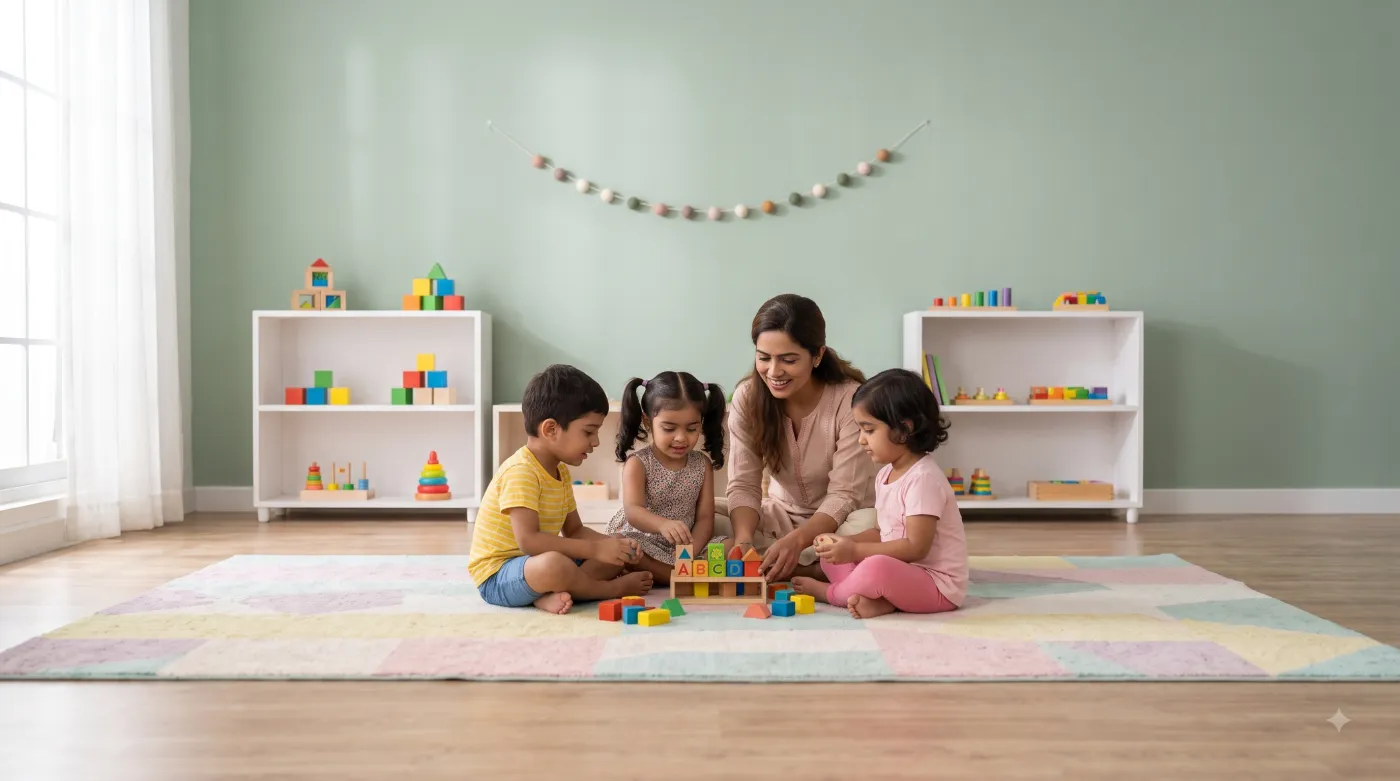
The two dominant curriculum approaches in Rajkot's preschool landscape are Montessori and Playway methods, and each serves different developmental priorities. Montessori education emphasizes self-directed activity, hands-on learning, and collaborative play. Children work at their own pace with specially designed materials that build concentration and practical life skills. Many parents in Rajkot appreciate Montessori for its focus on independence—children learn to dress themselves, pour their own water, and organize materials before they even begin formal reading instruction.
Playway methodology takes a different angle by centering learning on a child's natural instincts to explore and mimic. Teachers design activities around games, songs, storytelling, and sensory experiences that make abstract concepts concrete. This approach works particularly well for children ages 2 to 4 who are still developing language skills and social awareness. In Rajkot, Playway classrooms typically feature bright, activity-rich environments where movement and interaction drive engagement rather than seated instruction.
Some centers blend elements of both approaches, offering Montessori materials within a Playway-structured day. Parents should ask about daily schedules, teacher training backgrounds, and how learning outcomes are measured before enrolling.
Neighborhood & Campus Infrastructure
Preschool availability varies across Rajkot's key neighborhoods, and understanding this distribution helps parents narrow their search effectively. Derdi and Dhank, being more established residential zones, tend to have the highest concentration of centers with longer operating histories. Atkot and Jasdan serve families in developing areas, with facilities that may be newer but sometimes more limited in outdoor space. Ram para, with its mix of residential and commercial development, offers mid-range options across both price categories.
Fee structures in Rajkot typically range from INR 2,000 to 6,000 per month, with variation based on location, infrastructure quality, and whether meals or transportation are included. Centers in Derdi and Dhank with larger campuses and dedicated play areas generally sit at the higher end of this range. Parents should verify what each monthly fee covers—some quotes exclude uniforms, activity materials, or annual festival celebrations.
Physical standards at evaluated centers include minimum space requirements per child, ventilation and lighting specifications, and access to outdoor play areas where possible. Centers that lack outdoor space should compensate with regular field trips to parks or community centers.
Safety & Operational Verification
Safety assessment forms a core component of the evaluation process for Rajkot's indexed preschools. CCTV surveillance coverage is verified across entrances, classrooms, and play areas, with footage retention policies checked against stated practices. Parents should confirm whether cameras cover all zones and whether secure login access is provided for real-time viewing.
Caregiver-to-child ratios receive particular attention during evaluations. Recommended standards call for one trained caregiver for every 8 to 10 children in the 2 to 4 age group, with lower ratios preferred for infants and toddlers. Centers meeting this threshold demonstrate better supervision quality and quicker response times during emergencies or individual child needs.
Hygiene standards cover food preparation areas, restroom facilities, bedding practices, and illness management protocols. Evaluators check for regular sanitization schedules, hand-washing station accessibility, and staff health documentation. Parents visiting centers should observe these areas directly and ask about sick child policies, including communication procedures when children fall ill during school hours.