
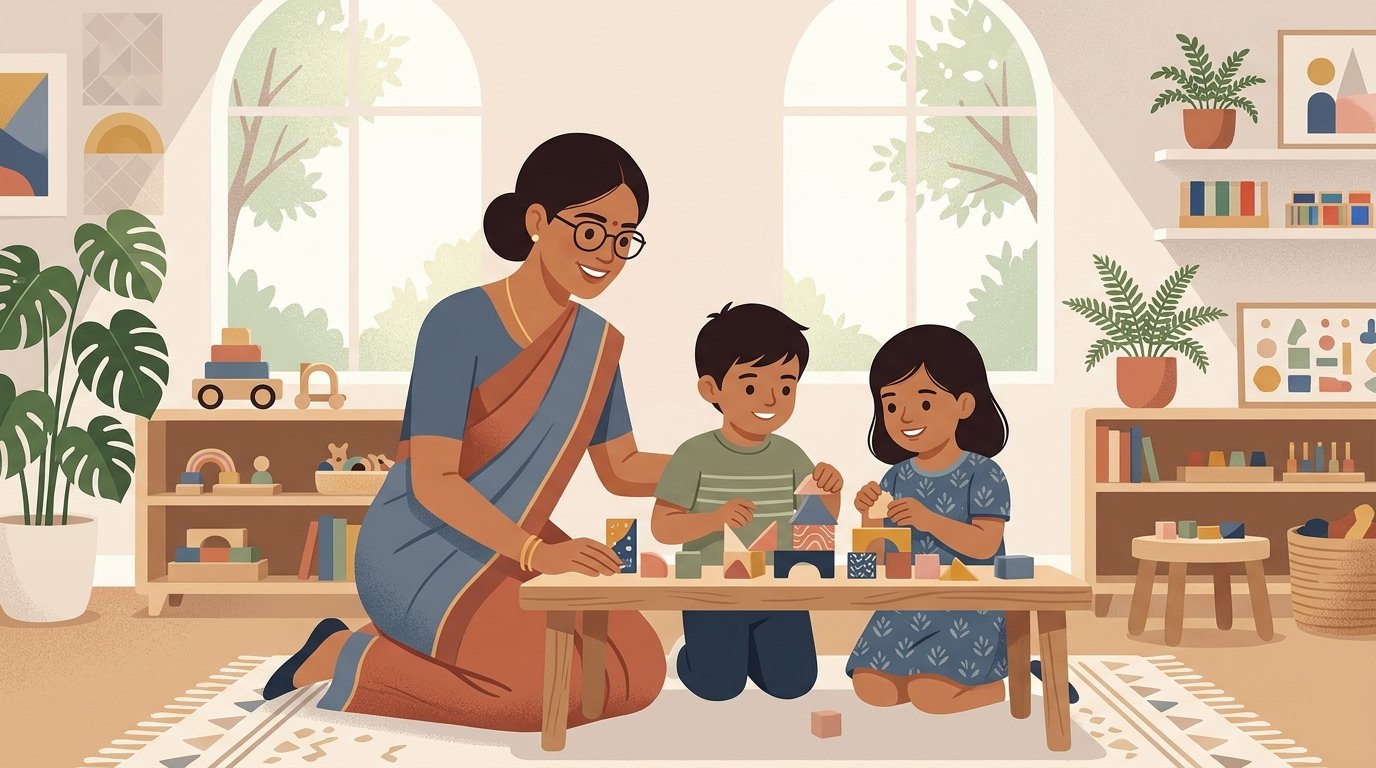
CBSE Mandates Play-Based Balvatika Framework for Foundational Learning in Affiliated Schools
EXECUTIVE SUMMARY & CONTEXT FOR PARENTS
In a sweeping structural transformation of early childhood education across India, the Central Board of Secondary Education (CBSE) has issued comprehensive updated guidelines governing the foundational stage Balvatika classes (ages 3 to 6) in all affiliated institutions. This critical policy shift fundamentally re-engineers how India's youngest learners step into formal schooling environments, pivoting away from traditional, rote-based kindergarten models toward a dynamic, activity-driven, and developmentally appropriate pedagogical framework. For parents navigating admission timelines, school selections, and early learning expectations, this mandate represents a monumental legislative alignment with the National Education Policy (NEP) 2020. No longer will preschool classes function as mere holding pens for academic acceleration or early alphabet memorization; instead, CBSE-affiliated schools are now legally and operationally bound to implement structured play-based learning ecosystems.
The directive arrives at a important juncture when urban Indian parents have increasingly felt pressured to subject toddlers to rigorous written examinations and heavy backpack burdens. Under the new CBSE framework, admission criteria, curriculum design, and classroom spatial layouts are being overhauled to protect childhood development. Parents can now expect transparent age-threshold enforcement—strictly establishing that children must complete 3 years of age for Balvatika-1 (Nursery), 4 years for Balvatika-2 (Jr. KG), and 5 years for Balvatika-3 (Sr. KG) as of March 31 of the academic session. Also,, the admission process must eliminate stressful interviews or screening procedures for both children and their parents, ensuring equitable access. By integrating experiential learning methodologies backed by the Ministry of Education's initiatives, this policy guarantees that early learning focuses on cognitive flexibility, emotional regulation, foundational literacy, and numeracy through joy, fundamentally redefining the parent-school partnership during these formative developmental years.
KEY TAKEAWAYS FOR INDIAN PARENTS
- Strict Uniformity in Age Criteria: The CBSE directive enforces an unyielding age benchmark across all affiliated schools. Children must attain the precise age of 3, 4, and 5 years for Balvatika 1, 2, and 3 respectively by March 31. This eliminates arbitrary cutoff dates previously set by individual institutions and brings standardization across states, putting an end to premature schooling pressures.
- Abolition of Screening Procedures: In direct alignment with the Right to Education (RTE) spirit, schools are explicitly barred from conducting formal interviews, oral evaluations, or written tests for toddlers and their families during the Balvatika admission cycle. Admissions must be managed through transparent, equitable processes such as draw-of-lots where demand exceeds capacity.
- Integration of the Jaadui Pitara Toolkit: Classrooms will no longer rely on standard textbooks and workbooks for the 3-to-6 age bracket. Instead, learning will be anchored in the "Jaadui Pitara" (Magic Collection) pedagogical toolkit—a treasure trove of toys, puzzles, flashcards, storybooks, worksheets, and local craft materials designed to build experiential and sensory-rich learning.
- Zero Homework and Assessment Relief: The mandate strictly prohibits assigning homework, formal examinations, or numerical grading systems for Balvatika students. Continuous formative assessment will take place exclusively through teacher observations, anecdotal portfolios, and developmental milestone tracking, safeguarding children from early academic burnout.
NEP 2020 Foundational Stage Age Cutoffs (Session 2026–2027)
Official Ministry of Education & State Board milestone benchmarks. Child must turn required age by June 1st / July 31st.
📥 Download State NEP Age Cutoff PDF & Circular Summary
Get the official age matrix, relaxation rules, and state GR breakdown sent directly via WhatsApp.
🏫 Browse NEP-Compliant Preschools in Your State
Explore verified schools with compliant Balvatika-1/2/3 infrastructure and age adherence.
OPERATIONAL & COMPLIANCE MANDATES FOR PRESCHOOLS
- Mandatory Infrastructure Redesign: School managements are required to reconfigure physical spaces, transforming traditional desk-and-chair classrooms into flexible, multi-activity zones. Institutions must allocate dedicated corners for free play, storytelling, art and craft, tactile exploration, and gross-motor skill development.
- Specialized Early Childhood Educator Recruitment: CBSE mandates that staff teaching Balvatika classes must possess specialized qualifications in Early Childhood Care and Education (ECCE). Schools can no longer deploy general primary or secondary teachers to handle foundational classrooms without accredited foundational stage training.
- Curriculum Alignment with NCF-FS: Educational programming must strictly mirror the National Curriculum Framework for Foundational Stage (NCF-FS). Lesson plans must prioritize the five key developmental domains (Panchakosha Vikas): physical (Sharirik), life-prana (Pranik), emotional/mental (Manasik), intellectual (Bauddhik), and spiritual (Aatmik) development.
- Resource Procurement and Compliance Audits: Schools are obligated to procure approved experiential learning resources, including the Jaadui Pitara materials, and maintain student-teacher ratios not exceeding 20:1. The board will conduct periodic compliance audits, and failure to meet infrastructural or pedagogical standards can invite severe administrative penalties or disaffiliation.
DETAILED OFFICIAL DIRECTIVE ANALYSIS
The latest circular issued by the Central Board of Secondary Education (CBSE) marks a definitive implementation phase of the National Education Policy (NEP) 2020 and the National Curriculum Framework for Foundational Stage (NCF-FS) released by the National Council of Educational Research and Training (NCERT). For decades, Indian early childhood education operated in an unregulated grey area, split between unorganized neighborhood playschools and overly academic kindergarten sections of formal K-12 institutions. By formally recognizing Balvatika-1, Balvatika-2, and Balvatika-3 as integral components of the school system, the CBSE has bridged the critical chasm between unorganized care and formal primary schooling.
A core pillar of this official directive is the scientific grounding of age-appropriate pedagogy. Citing extensive neurological and developmental research, the board emphasizes that the human brain develops at its most rapid pace during the first eight years of life. Forcing abstract symbols, numerals, and alphabets upon three-year-olds stunts creative problem-solving and induces chronic educational anxiety. Consequently, the CBSE mandate explicitly outlaws rote memorization and chalk-and-talk methods in Balvatika classrooms. Learning must occur through the Panchakosha framework, utilizing local culture, art, mother tongue integration, stories, and play. The implementation of the Ministry of Education's "Jaadui Pitara" serves as the operational centerpiece of this directive, ensuring that children manipulate physical objects to grasp foundational concepts of mathematics, spatial awareness, and linguistic expression.
From an implementation timeline perspective, CBSE-affiliated schools have been instructed to transition their infrastructure, retrain faculty, and overhaul admission guidelines immediately. State councils such as SCERTs across various states are closely mirroring these directives to synchronize state-board schools with national standards, creating a unified ECE paradigm nationwide. Compliance is no longer voluntary; regional CBSE inspection committees have been empowered to review foundational stage classrooms, checking for child-friendly furniture, safe indoor-outdoor play equipment, and ECCE-certified teaching personnel. By enforcing these rigorous, child-centric mandates, the CBSE is engineering a generational shift, ensuring that India's youngest learners build a joyful, resilient, and cognitively robust foundation for lifelong learning.